





Si l'industrie textile européenne a presque disparue du fait de la concurrence de la Chine, il existe quelques exceptions. C'est ainsi qu'il y a quelques jours une chaine de télévision présentait une entreprise française installée en Bretagne qui fabriquait des vêtements en coton et qui faisait des bénéfices. Une entreprise textile qui ne connaissait pas la crise. Son secret ? Elle transformait du coton biologique.
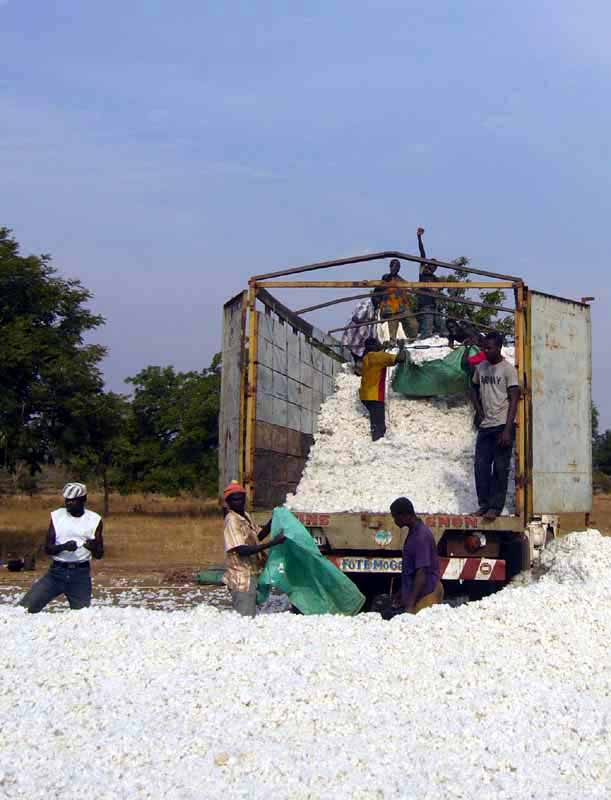 Or justement, il y a trois semaines, avec un ami, j'ai eu l'occasion de faire la route Po – Diébougou. Je me suis arrêté pour bavarder avec des producteurs de coton qui étaient en train de charger leur récolte. Le chauffeur du camion nous a dit qu'il allait conduire sa marchandise jusqu'à Banfora. J'ai manifesté mon étonnement : « Pourquoi ne pas la décharger à l'usine d'égrenage de Diébougou ? » C'est alors que j'ai appris qu'il s'agissait de coton bio-équitable.
En poursuivant la conversation, j'ai appris (si je ne me trompe pas !), qu'ils allaient le vendre à 272 F le kilo, plus une prime dite « équitable » de 34 F pour leur association. Ce qui fait un total de 306 F (à comparer aux 165 F du coton conventionnel). Ils étaient relativement satisfaits de leur récolte, même s'ils n'avaient pas atteint leur objectif. Ils avaient obtenu un rendement de 550 kg/ha au lieu des 600 kg, ou plus, escomptés.
Il est vrai que le coton bio-équitable, demande plus de travail que le coton conventionnel. Mais il est vrai aussi que les dépenses financières sont moindres. Surtout si cette culture est associée à la culture du sésame biologique. Cela permet d'économiser sur les coûts de certification.
Mais on peut poursuivre la réflexion... Depuis octobre 2001, où le cours mondial du coton était au plus bas, combien de rencontres internationales où l'on répète qu'il faudrait transformer le coton africain sur place? Mais on ne voit toujours rien venir. C'est que la question est simple, mais la solution difficile. Le coût de l'énergie est très élevée au Burkina. Comment développer une industrie textile tout en faisant venir massivement des fripes du monde entier ?
L'exemple de la Bretagne devrait nous faire réfléchir. La solution n'est-elle pas de s'orienter de façon significative vers le coton biologique et de le transformer sur place ? La question mérite d'être approfondie.
Koudougou, le 14 janvier 2009
Maurice Oudet
Président du SEDELAN