


|
The ruins of Loropéni in south-west Burkina Faso listed as part of the World Cultural Heritage by Unesco In this month of August the farmers of Burkina are at work. We continue to be at their side. But we are also aware that many of our correspondents are on holiday. Therefore we would like to take you on a visit to the ruins of Loropéni, which were recently classified by Unesco as part of our World Cultural Heritage.
If looking out attentively at 2-3 km from Loropéni (40 km from Gaoua on the motorway to Banfora in the south west), you will find a road sign bidding you to steer off the main road and delve into a magnificent forest. And soon you will see a wall of laterite stone, held together by a mortar of fine gravel and clay. You are standing at the foot of the remnants of an ancient fortress. Its size is impressive, its height is about 6 m (approximately 19.2 feet), it is nearly square and runs at a length of 105-106 m (336 feet).
The ruins of Loropéni are made up of laterite quarry stones cut to size as well as natural blocs of stone to form the 6 m high wall surrounding a vast, abandoned site. According to recent research, its origins go back to the 11th century and it was flourishing in the 14th and 17th centuries.
Obviously the wall has cracks and missing stones, offering a good opportunity to take a nice picture (which you may then enlarge, just like your other photographs) of the interior. Inside the wall vegetation has taken over. And it is by using the dating technique of the Carbon 14 molecule from well preserved deadwood, that it has been possible to ascertain that this fortress city was indeed abandoned in the 17th Century.
Recent research findings have unveiled part of the secrets of these fortresses, “discovered” in 1912 by the Frenchman Henri Labouret. Contrary to the declarations of Labouret, who was a colonial governor and who maintained that the fortresses had been built by the Lobi people, the team of Professor Kiethéga rather attributes the construction work to the Koulango population, and ethnical group which is now split between the south east of Burkina and the Bouna region in the north east of Ivory Coast. They mined and processed gold in the area. The last known occupation of the site was in the 17th Century. Research has confirmed that for a very long period of time caravans linked this gold-mining region to the trading towns situated at the bend of the river Niger, such as Djenné, Mopti and Timbuktu, passing by Bobo Dioulasso in Burkina. In
cidentally the construction of these fortified ramparts came about as a reaction to the insecurity created by the gold mining operation. Loropéni is a defence system, developed by the inhabitants as a protection against assault by people as well as attacks by lions and buffaloes, which in ancient times were a real danger. (It should be noted that the name Loropéni means Buffalo city in the Loron language).
At some places the wall has collapsed, eroded by the rains. Therefore the trees which have been able to take root here, could well be a threat to the fortress. These remains deserve not only to be classified as World Cultural Heritage but also to be protected against rough weather and degradation by humans and animals.
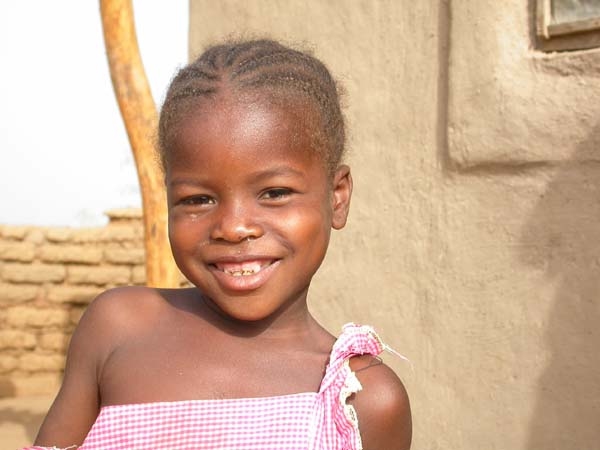
Children should also have protection. Against tourists …As occurred during our recent tour, visitors think they have an obligation to offer candy and gifts of various kinds to the children ,who immediately come running up to them. If no precautions are taken now, the children of Loropéni will drop out of school to go begging along the ruins (some already have !). The site, instead of being a “gift to humankind” as it indeed is, could turn into a poisoned present. Why no start an association to promote the education of Loropéni children (by offering them scholarships for example)? Tourists being asked not to give gifts directly to the children could instead be encouraged to put 500 CFA francs into the fund of such an association in support of Education for these children. Our congratulations to our guide Alexis Diourbiel for his enlightening comments and passionate involvement. Koudougou, August 13th 2009 Maurice Oudet Director, SEDELAN |